
The star of the exhibition is the monumental sculpture Piano Bull, over a meter tall, transported from Madrid to Asunción to become the symbolic centerpiece of this journey. “It is a unique piece, made of bioplastic and ceramic, coated with fiberglass, hand-painted and lacquered, which gives it a shine and a mirror-like effect,” Boesmi explained.
Art critic Javier Díaz-Guardiola, coordinator of ABC Cultural (Spain) and author of the curatorial text for the exhibition, highlighted that Order in Chaos “brings together works developed in an artistic investigation that addresses concepts such as transformation, identity, and the tension between nature and artificiality.”
The Piano Bull is not a whim or an occasional figure, but a motif laden with personal history for Boesmi. “It’s a character that has been with me since childhood. I used to draw it in my notebooks as an imaginary toy, and over the years it became my most personal symbol. It represents the union between strength and sensitivity: the piano as music and emotion, the bull as power and resilience,” the artist explained.
In Spain (where he currently resides), the figure of the bull acquires even greater symbolic weight. “ The bull is laden with meanings of power, and these iconographies (the bull, the Spanish flag) are politicized. I am interested in using them and, through that gesture, decolonizing what I have learned, questioning it, and giving it new meaning, ” he added.
The sculpture, measuring over 117 cm high by 130 cm long, required a complex technical process combining 3D printing, fiberglass, and hand finishing. Its transport to Paraguay was " almost an odyssey ," according to the artist himself, but upon seeing it installed in the gallery, he said that " all the effort was worth it ."
In addition to the centerpiece, the exhibition includes bronze sculptures from the Piano Bull series, presented in a limited edition of eight certified pieces, each weighing 7 kilos, along with a new series in hand-painted resin. “ It’s an evolution from my previous work, which was handcrafted using 3D printers ,” Boesmi explained.
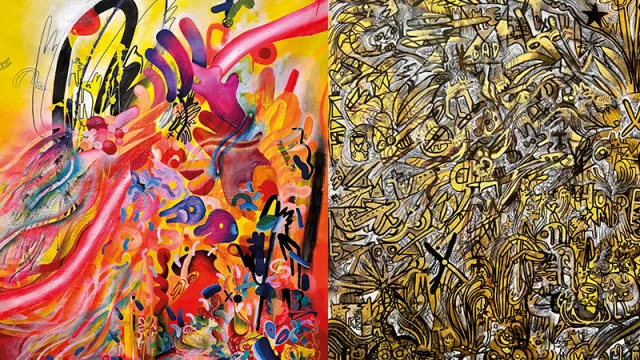
The exhibition is rounded out with a selection of paintings created between 2023 and 2025, which engage in direct dialogue with the sculptures. “ For me, everything is connected. I paint and sculpt from the same symbolic universe. The paintings are like visual scores, made of contrasts and rhythms, something very emotional and very mental at the same time. For me, the paintings are questions and the sculptures are answers ,” she reflected.
Video art also occupies a prominent place. Far from considering it a separate discipline, Boesmi describes it as an extension of painting. “ Video art allows me to expand painting in time. While painting freezes an image, video lets me show much of what is essential and invisible. For me, they are video-paintings: paintings that move and sculptures that pulse in pixels .”
One of the most original sections of Order in Chaos is the Clandestine Curatorships project, in which Boesmi toured the streets of downtown Asunción to rescue graffiti and transform it into neon works.
“ With this project, I want people to look at the walls downtown, to pay attention to their surroundings. Often we're on our phones in the car and we don't really see the city. That's why in the exhibition I'm displaying the neon sign alongside a photo of the original graffiti, so that the viewer understands that this comes from the street ,” he emphasized.
Beyond its aesthetic impact, Boesmi sought to make this exhibition inclusive. Inspired by a visit from a visually impaired person to a previous show, he implemented Navi Lens codes that allow access to curatorial texts and commentaries on the artworks via mobile devices. “ I wanted the experience to be accessible, so that visually impaired viewers could also explore the exhibition in their own way ,” he said.
In parallel, the artist continues with his Experimental Workshops Project, through which he will offer free workshops aimed at art students and emerging creators who wish to explore new plastic languages.
Born in Salta, Argentina, Boesmi grew up in Asunción, where he completed his academic training. “ I’ve been drawing and painting for as long as I can remember. In the early 2000s, I started showing my first works in galleries and realized it wasn’t just about painting, but about translating ideas into images and finding my own artistic language ,” he recalled. Today, he divides his time between Madrid and Asunción, and this constant movement is reflected in his work. “ I suppose that mix helped me grow as an artist ,” he acknowledged.
